
‘Beyond the Water’ art exhibit brings hope to the halls of Stewart’s Caring Place
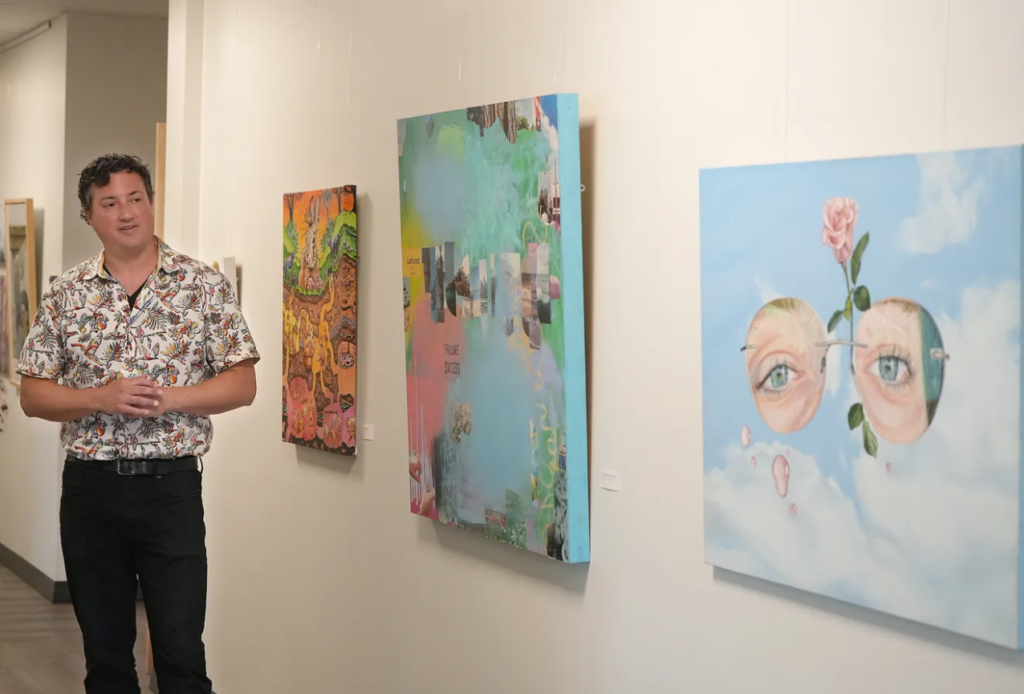
When Hurricane Helene passed through Asheville, North Carolina, in September 2024, more than 300 local artists lost their galleries, their artwork and their communities.
Mac and Allyse Love, co-founders of ART x LOVE in Akron, looked for a way to support the art community of over 600 artists − many of whom worked in Asheville’s highly affected River Arts District − and were scrambling to rebuild along with the rest of the city.
The result was a collaboration with Stewart’s Caring Place to create an art installation, “Beyond the Water,” which contains 63 works of art from 31 Asheville-based artists.
The exhibition, which opened March 19, is free to the public Monday through Friday from 9 a.m. to 5 p.m. at the Stewart’s Caring Place: Thomas And Lisa Mandel Cancer Wellness Center, located at 3501 Ridge Park Drive in Fairlawn. Its final day will be July 18.
Stewart’s Care Center, a non-medical wellness center for those who have been impacted by a cancer diagnosis, curates two art exhibits in its hallways each year with the help of Mac and Allyse. Typically, the exhibits feature work from local artists.
“I think it’s like a human instinct when tragedy happens to really like band together,” said Greg Carr, an Asheville artist whose work is exhibited in “Beyond the Water.”
This gallery is different. All the money from sales is returned to the artists in an effort to continue the renewal of Asheville’s art community after the flood. As of June 16, the gallery has made $3,165 for Asheville artists with seven pieces being sold.
“It just made so much sense to us to be able to feature these artists and bring a sense of hope in all meanings of the word to anyone who walks through our halls,” Stewart’s Caring Place President and CEO Sarah Vojtek said.
Vojtek said the gallery seemed like a perfect way to brighten up the halls for those experiencing cancer diagnoses at Stewart’s while also helping artists rebuild in Asheville.
The exhibit, however, wasn’t the first step the Loves took to help Asheville’s affected artists. They first realized the need for some sort of fundraiser through a close friend and his partner, Erica Schaffel, a watercolor artist, who had moved to Asheville a few years prior. Schaffel wanted there to be a way for those looking to help to donate directly to the artists. Many of the fundraising efforts or GoFundMe links focused predominantly on property owners whose homes or businesses were destroyed.
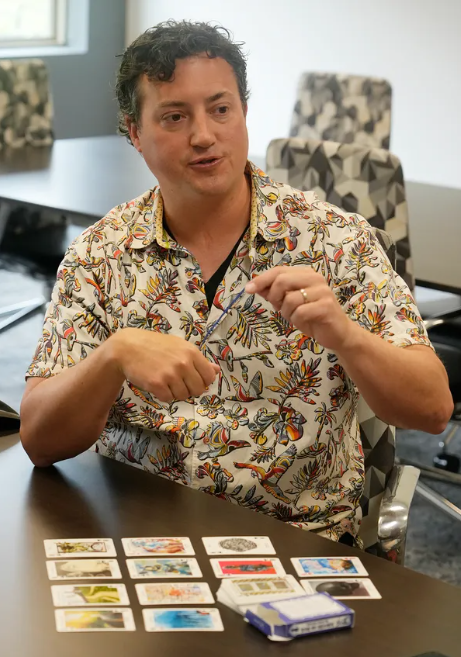
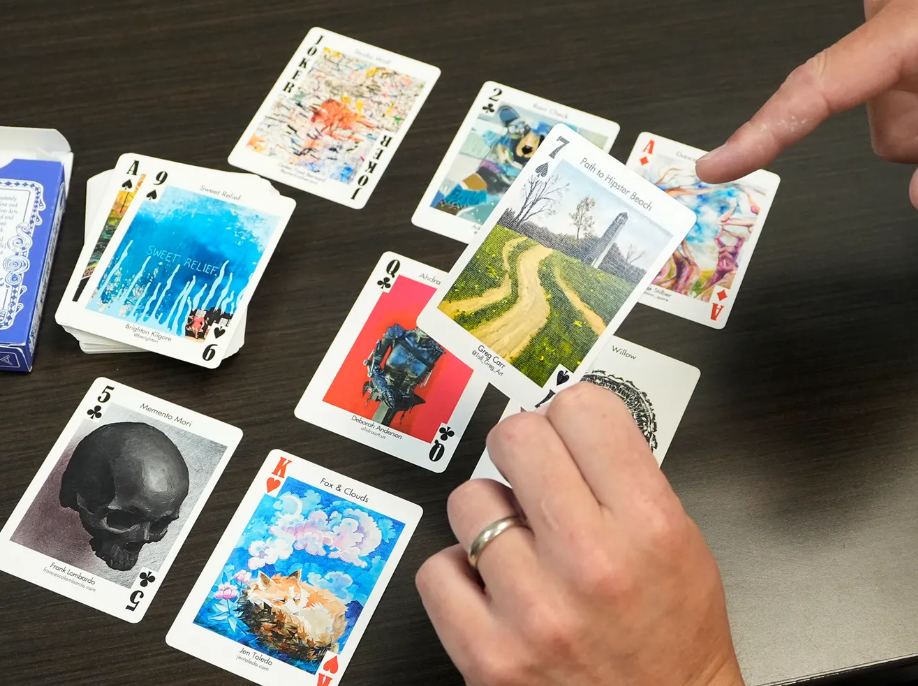
Schaffel enlisted the help of Mac and Allyse, who had previously used cards as a way to raise money for local Akron artists and had produced three different editions with proceeds going back to artists. The two designed the cards using work from 54 different artists whose art had been impacted by Hurricane Helene. The project also includes a coffee table book, designed by Schaffel and Asheville artist Andrew Beck, which contains each of the 54 artists’ stories.
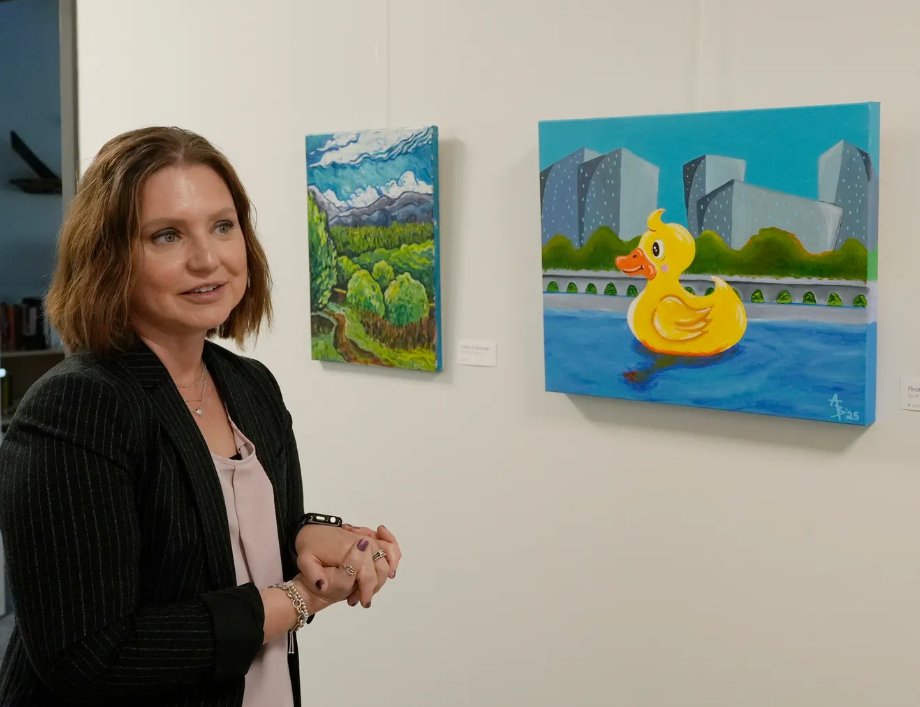
One of Beck’s pieces, called “Float On,” included in the gallery, depicts a rubber duck floating through a river. Beck said the bright yellow duck seemed appropriate for the Rubber City, but he also wanted to highlight a moment of joy and silliness amid the destruction.
The proceeds from the Asheville edition of the deck, “Asheville on Deck: The Flood Collection,” which was released in January, goes back to the artists. In total, sales from the cards have raised $260,000. The cards are sold at a variety of small businesses in Asheville and online at thefloodcollection.com.
“It’s a very eclectic range of work,” Mac Love said. “Almost all of the work that you see here featured in this deck is work that was lost in the flood as well.”
Schaffel said more 200 people submitted work. Each person who applied but didn’t make it into the collection was given $100. Each contributing artist made $1,400 after the the pre-sale closed for both the card deck and the book, and Schaffel expects each to make a total of $3,000 after more inventory sells.
“I feel like I accidentally started a nonprofit,” Schaffel admitted. “Which is definitely not the intention. It’s been a full-time volunteer job now for nine months now.”
Artist shares meaning behind piece in Stewart’s Caring Place exhibit
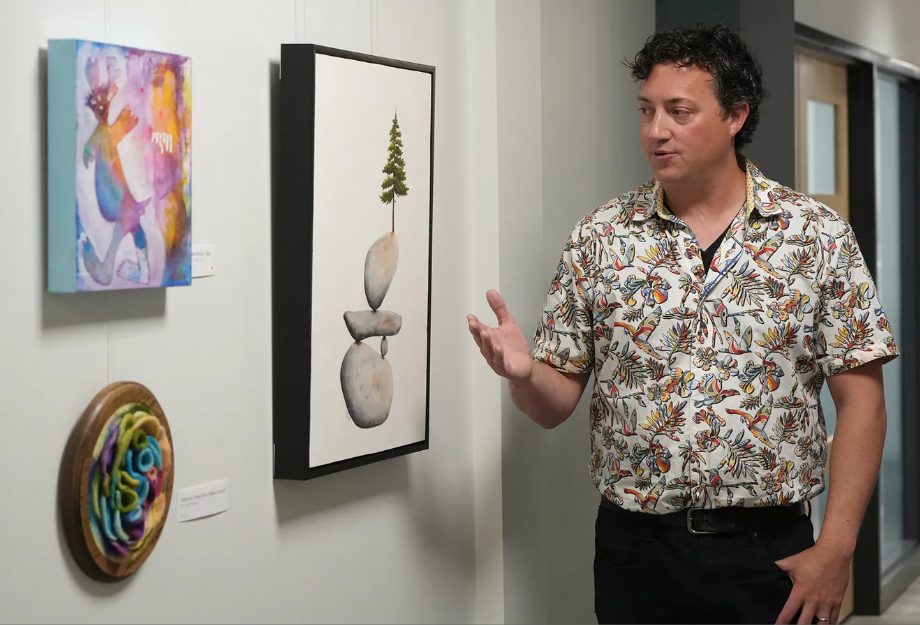
One of Schaffel’s watercolor pieces, “Balancing Act 8,” is exhibited in the gallery. The piece, which is part of a series, depicts a cairn with a pine tree growing out of it. Schaffel said the cairn was to show that she was going in the right direction.
“When I see trees that are sort of growing out of the rocks, almost, that feels like these trees are growing in a place where they just shouldn’t ever be able to,” Schaffel explained. “It’s like such a sign of strength.”
Mac Love said he drove down to Asheville himself over Presidents Day weekend to personally pick up all the pieces in a U-Haul truck. He said while he was there, some artists got word of the exhibit and rushed to give him their artwork before he drove back.
A few of the pieces from the deck that were almost lost in the flood are also featured in the exhibit. Some were even recovered from the wreckage of the flood, including a piece by Carr called “Path to Hipster Beach.” When the deck was being put together, Carr thought the landscape piece was gone for good.
“When you look at it, you can actually still see it’s quite dirty,” Mac Love said. “There’s some dried mud and other distress marks on it. He never cleaned it. He just kept it exactly as it was.”
Carr, whose entire storage unit was condemned because of the flooding, said at first he tried to hose off some of the work he was able to grab from the storage. He quickly realized he was harming more than helping.
“The whole thing was so sad and tragic that I just kind of want to move on from it instead of trying to, like, scrub it off,” Carr said.
In one of Carr’s pieces that was damaged, he said mud and debris fell on the artwork in a way that added to the pieces instead of taking away from them.
Following the flooding, some artists had an option to receive rescue funds from the federal government. However, the money raised from the set of playing cards actually turned out to be more than the government money being given out.
Like the cards, the exhibit in the wellness center contains a diverse display of voices from before, during and after the flood. The gallery includes paintings and drawings both small and large as well as sculpture, jewelry and fashion.
‘Asheville’s open’
Some featured artists, such as Davis Perrot, created a piece for the gallery in a style completely different from what he did before the flood. Other artists, like Hannah Rothstein, choose to display an older piece of hers since so much of her artwork was affected by the floods.
Rothstein’s exhibited piece, “Remembering,” is a pensive portrait of man whose face stuck out to her in a National Geographic magazine. Yet her current style focuses on vintage reinterpretations of climate changes. She said the style sometimes feels ironic, considering so much of her art was lost in a climate-related disaster.
Chris Jelhy, another artist, found the flood to be a turning point for his artwork’s subject matter.
“It forced me to create work and look at the way that I make work differently in conjunction with what happened in Asheville because I was already working on things that were about the locale of Asheville landscape,” Jehly explained.
While the majority of Asheville’s River Arts District was damaged by the flooding, new galleries have emerged and artists have joined each others’ spaces to make room for impacted people. Tourism has decreased substantially making it difficult for the city to rebuild.
“Asheville’s open and would love for people to, you know, come visit and experience this beautiful community firsthand,” Schaffel said. “We would be so grateful.”
Reporter Julia Pentasuglio can be reached at jpentasuglio@gannett.com.
Originally published by Akron Beacon Journal on June 22, 2025.